


Carta – the Gate to another dimension?
Vizualizare hartă mărită


“Red people, a tad shorter than our kind, came out of a mountain riding red horses. There were about two hundred of them, and they started preaching all sorts of things in front of the people. Suddenly, they ran all over the people who were listening and returned to their cave, never to come out again. They vanished, all but one, who got caught by his hand by a man. Alas, the little devil turned that man’s hand forever red and then ran off. During the following year, some kind of misfortune came upon almost all who witnessed that terrible event.”
Western Europe heard a lot of red creatures on red or fiery steeds, of demons and doomsday visions. But it is for the first time that the western imagination finds its way into the east, at Carţa, in Transylvania. What could have determined this transfer and, more precisely, what caused the appearance of a Transylvanian Saxon settlement in a western chronicle?
The exact founding date of the Cârţa monastery (Latin: monasterium beatae Mariae virginis in Candelis de Kerch) is unknown but is estimated that it was founded by the Cistercian Rite Monks between: 1202–1206. It is one of the oldest Cistercian monasteries in Europe and the oldest in Eastern Europe, representative for the early Gothic style. The Church was built in shape of cross. It was one of the most important and impressive fortified churches in Transylvania and the territory on which it was built was donated to the King Benedict of Transylvania by King Andrew II of Hungary. The first documentary attestation of the church dates back since 1223 in a document from the times of King Andrei II which confirms a donation of a Cistercian monk, Gocelnius, to the monastery. This document states that the territory, on which the monastery was built, was awarded by magister Gocelinus, for the blessing of his soul, through the Transylvanian king Benedict. This land, stated the document, was ”terra exempta de blaccis” or land taken from the Walachia’s. Benedict was Transylvanian king between 1202–1206 and 1208-1209. This means that the founding date must fall between 1202 and 1209. An additional document, the General Chapter of the Cistercian Order from 1206, further narrows the date of founding, mentioning the presence of a Cistercian monk from Transylvania, most probably from Cârţa, at the Cîteaux Abbey, in Burgundy, the main abbey of the Cistercian order. Summing up this historical data, the date of the monastery’s founding by the Cistercians monks can be established between 1198 and 1208.
How the Fortified Churches of Carta appeared
In the 12th century, the King Geza II of Hungary began an intense period of development in Transylvania, the area being colonized with Germans. This is the period when the Teutonic Knights appeared in Transylvania, together with the Cistercian Monks, who built the first monasteries. The Church has always played an extremely important role in the society and during troubled times it was used as a shelter by those chased away by the foreign invasions. Thus, the churches were properly built with thick walls, in order to offer protection to the ones it sheltered. The Saxons of Transylvania continued building fortified churches long time after the invasions ceased.
The Church ruins can be seen on the road between Brasov and Sibiu in the Olt valley. Over time, the Church was damaged several times by Turks and Tatars, in 1241 being almost entirely destroyed. Nearly the entire church needed to be rebuilt in 1250. The new building was executed in what is called early or Burgundy gothic – a style that still used a fair amount of typically Romanesque building techniques. At the same time that construction was taking place at the Carţa building site, this early gothic style was also being used at the Saint Bartolomeu church in Braşov. Although less visible now, the Cistercian style had a strong influence on the churches of Prejmer, Hărman, Sanpetru and Feldioara. Elements of this style were also adopted in other buildings in the Hartibaciu valley, where the church of Carţa was regarded as a worthy model. In 1474, the King Matthias Corvine abolished the Church due to numerous complaints he received from villagers of Carta, oppressed by the higher and higher taxes imposed by the Church Abbot of that period, Raymund Barenfus. Even though it was abolished, the Fortified Church of Carta continued its activity and the religious sermons are still celebrated today.
What you can see at the Fortified Church of Carta
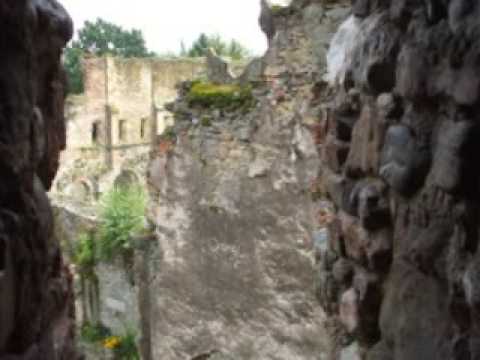
All that is left of the old cells of the monks is a high wall located south of the church that still preserves a two-party window and round-arch ones. Inside the courtyard of the parish house, the little hammers on the water mill still knock on wood. They almost seem to say that time will always keep passing.
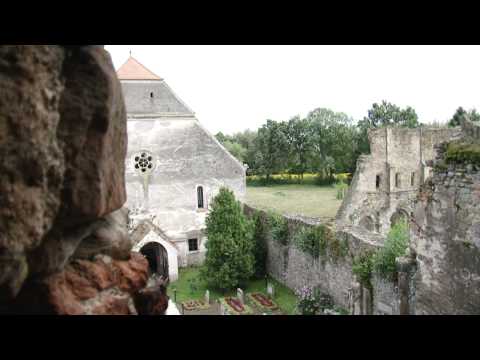
The Church preserves only the choir, the apse and south wall of the cells. The church choir consists of arches that join in a keystone which depicts the Virgin Mary, who is also the protector of the religious place. Other decorations of the church are the sunflower plates and round stained glass windows, arranged in six lobes. The former central nave of the Church of Carta houses a cemetery, built in memory of German soldiers fallen in the First World War, during the Battle of Sibiu. In the churchyard, there is also a water mill with little hammers.
The Cistercian monastery introduced and helped develop Gothic art in the region. The first buildings of the monastery were built, according to Cistercian customs, using perishable materials, most probably wood, in the founding period (1205–1206). A few years later, approximately 1210-1215, a stone chapel of small dimension (around 8–10 m) and massive walls, the oratorio, was built close to the original wood buildings. The construction of the main stone edifice started a little bit later, most probably between 1220 and 1230. The construction occurred in two stages, separated by the Great Mongol invasion of 1241. In the first stage of construction, the main elements are of Romanesque influence. The general plan was traced and the walls were erected up to a height of about 3–4 m. In 1260 the works were restarted under a new architect trained in the mature Gothic architecture, and with the help of a new masons’ workshop. During this period, the old stone oratorio was dismantled and on its foundations was built a part of the north wing of the transept and a part of the choir with the polygonal apse. At around 1300, the church and the east wing of the Cărţa Monastery were already finished and the works on the south side will continue for about two decades.
The Legend of the Haunted Abbey in Romania
The old Cistercian Abbey from Carta attracts thousands of tourists annually due to its architecture and history, but also due to the legend that the church would be haunted by the old monks that used to live there. The legend says that cistercian monks fasted all year and sometimes ate cheese and boiled beech leaves. They all slept in one room on hay. They would wake up at three o’clock in the morning and by the evening they would have service every three hours. Because of the poor life conditions, the monks died at the age of 35-40 years and were buried at the Abbey. Their graves are in the yard of the monastery. Some people say that the place is haunted and that in the cellar the chairs are sometimes moving and the walls are vibrating. It is said that even the priests that served there witnessed that phenomenon.
The Cistercian Order
The Order of Cistercians – Latin: Order Cisterciensis or, alternatively, OCSO for the Trappists (Order of Cistercians of the Strict Observance)) is a Roman Catholic religious order of enclosed monks and nuns. They are sometimes also called the Bernadine’s or the White Monks, in reference to the color of the habit, over which a black scapular is worn. The emphasis of Cistercian life is on manual labor and self-sufficiency, and many abbeys traditionally supported themselves through activities such as agriculture and brewing ales.
The term Cistercian (French Cistercien), derives from Cistercium, the Latin name for the village of Cîteaux, near Dijon in eastern France. It was in this village that a group of Benedictine monks from the monastery of Molesme founded Cîteaux Abbey in 1098, with the goal of following more closely the Rule of Saint Benedict. The best known of them were Robert of Molesme, Alberic of Cîteaux and the English monk Stephen Harding, who were the first three abbots. Bernard of Clairvaux entered the monastery in the early 1110s with 30 companions and helped the rapid proliferation of the order. By the end of the 12th century, the order had spread throughout France and into England, Wales, Scotland, Ireland, Spain, Portugal, Italy, and Eastern Europe.
The keynote of Cistercian life was a return to literal observance of the Rule of St Benedict. Rejecting the developments the Benedictines had undergone, the monks tried to replicate monastic life exactly as it had been in Saint Benedict’s time; indeed in various points they went beyond it in austerity. The most striking feature in the reform was the return to manual labor, especially field-work, a special characteristic of Cistercian life. Cistercian architecture is considered one of the most beautiful styles of medieval architecture. Additionally, in relation to fields such as agriculture, hydraulic engineering and metallurgy, the Cistercians became the main force of technological diffusion in medieval Europe. The Cistercians were adversely affected in England by the Protestant Reformation, the Dissolution of the Monasteries under King Henry VIII, the French Revolution in continental Europe, and the revolutions of the 18th century, but some survived and the order recovered in the 19th century. In 1891 certain abbeys formed a new Order called Trappists (Ordo Cisterciensium Strictioris Observantiae – OCSO), which today exists as an order distinct from the Common Observance.
| Home | Bucharest | Dobrogea | Moldova | Wallachia | Transilvania |
|---|---|---|---|---|---|


