




Right near the center of Bucharest, near the Dambovita river, on a small hill, you can see the sillouhette of a small church named the church of Bucur the shepherd. According to the legend, Bucharest was founded by a shepherd called Bucur who settled with his sheeps in these places and gave his name to the future capital of Romania.
But nobody knows exactly the period when Bucur lived. The church “Bucur the Shepherd”, dedicated to Saint Athanasius and Cyril was built in 1626 by the monks of the “Radu Voda” Monastery, in the vicinity, on the foundations of an older church, dating from the fifteenth century. At the beginning the church served as a chapel for the Radu Voda Monastery because both of them were on the same hill. But in the 19th century the hill was sectioned to make place for a new street. From the street up to the church there are 33 stairs symbolizing the age when Jesus was crucified. The church is small, simple and quite humble but so peaceful and beautiful.
The legend also says that Bucur the shepherd has his home on this hill, so this place is considered to be the place where Bucharest was founded. Near his house Bucur built a wooden church to be close to God together with his family. There is also an inscription from the old times that was hidden in the foundation of Radu Voda Monastery from the king Mircea the Old saying that in 1416 he built a larger church on the place of the former wooden church of Bucur on a hill near Dambovita river where were burried the soldiers who died in the battle with the turks in 1416. In that place were discovered lot of bones so a wooden cross was put there.
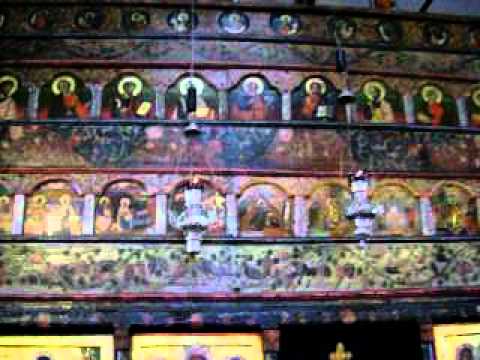
The church built by Mircea the Old was destroyed in 1595 by turks led by Sinan Pasa but was rebuilt in 1626. The existing church is the one rebuilt in 1626 by the monks led by Athanasie, from Radu Voda Monastery situated nearby on the same hill in the past. The existing altar was painted in 1705 (the date appear of the icon of Joan the Baptist).
Nu departe de centrul Bucurestiului, langa raul Dambovita, pe un mic deal, se poate observa silueta micutei biserici numita biserica lui Bucur ciobanul. Dupa cum spune legenda, Bucurestiul a fost fondat de un cioban pe nume Bucur care s-a stabilit cu turma sa de oi in aceste locuri si a dat numele sau viitoarei capitale a Romaniei.
Dar nimeni nu stie cu exactitate in ce perioada a trait Bucur. Biserica “Bucur Ciobanul”, consacrata Sfintilor Atanasie si Chiril a fost construita in 1626 de calugarii de la Manastirea “Radu Voda”, aflata in vecinatate, pe fundatiile unei biserici mai vechi, datand din secolul 15. Initial biserica a servit ca o capela pentru Manastirea Radu Voda deoarece amandoua erau situate pe acelasi deal. Insa in secolul 19 dealul a fost sectionat pentru a face loc unei noi strazi. De la strada pana sus la biserica se urca pe 33 de trepte care simbolizeaza varsta la care Iisus a fost crucificat. Biserica este mica, simpla si chiar umila insa emana foarte multa liniste si frumusete.
Legenda mai spune ca Bucur ciobanul isi avea casa pe acest deal, deci acest loc este considerat a fi locul de intemeiere al orasului Bucuresti. Langa casa sa Bucur a construit o bisericuta de lemn pentru a fi mai aproape de Dumnezeu impreuna cu familia lui. Mai exista o inscriptie din vechime care a fost ascunsa in fundatia Manastirii Radu Voda de pe vremea Voievodului Mircea cel Batran in care se spune ca in 1416 acesta a construit o biserica mai mare pe locul in care se afla fosta bisericuta de lemn a lui Bucur pe un deal langa raul Dambovita unde au fost ingropati soldatii care au murit in luptele impotriva turcilor in 1416. In acel loc au fost descoperite o multime de oase si de aceea o cruce de lemn a fost asezata acolo.
Biserica construita de Mircea cel Batran a fost distrusa in 1595 de turcii condusi de Sinan Pasa dar a fost reconstruita in 1626. Biserica de azi este cea reconstruita in 1626 de calugarii condusi de Athanasie, de la Manastirea Radu Voda situata langa biserica lui Bucur ciobanul, pe acelasi deal in vechime. Altarul existent a fost pictat in 1705 (data apare pe icoana Sfantului Ioan Botezatorul).
| Home | Bucharest | Dobrogea | Moldova | Wallachia | Transilvania |
|---|---|---|---|---|---|


